Debussy Golliwogg's Cakewalk from Children's Corner Cello and Piano
The famous Golliwogg's Cakewalk is the final piece from Debussy's cycle Childrens Corner which consists of 6 miniatures for piano, written for his daughter in the years 1906-1908.
The style corresponds to that of ragtime, a dance which was in vogue around the turn of the century. In the middle section, he parodies several times the beginning of the opera Tristan and Isolde by Richard Wagner with whom Debussy had a rather ambiguous relationship.
The present arrangement now allows musicians to play the popular movement in a version for melodic instrument with accompaniment.
Arranger: Wolfgang Birtel
Product Information
Product Information
Shipping & Returns
Shipping & Returns
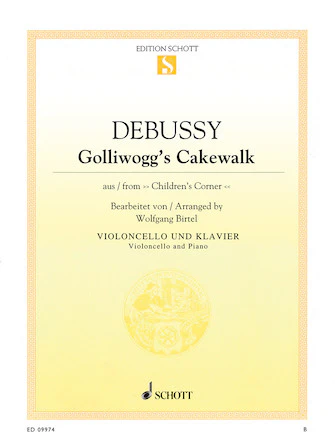
Debussy Golliwogg's Cakewalk from Children's Corner Cello and Piano
Debussy Golliwogg's Cakewalk from Children's Corner Cello and Piano
The famous Golliwogg's Cakewalk is the final piece from Debussy's cycle Childrens Corner which consists of 6 miniatures for piano, written for his daughter in the years 1906-1908.
The style corresponds to that of ragtime, a dance which was in vogue around the turn of the century. In the middle section, he parodies several times the beginning of the opera Tristan and Isolde by Richard Wagner with whom Debussy had a rather ambiguous relationship.
The present arrangement now allows musicians to play the popular movement in a version for melodic instrument with accompaniment.
Arranger: Wolfgang Birtel
Product Information
Product Information
Shipping & Returns
Shipping & Returns
Description
The famous Golliwogg's Cakewalk is the final piece from Debussy's cycle Childrens Corner which consists of 6 miniatures for piano, written for his daughter in the years 1906-1908.
The style corresponds to that of ragtime, a dance which was in vogue around the turn of the century. In the middle section, he parodies several times the beginning of the opera Tristan and Isolde by Richard Wagner with whom Debussy had a rather ambiguous relationship.
The present arrangement now allows musicians to play the popular movement in a version for melodic instrument with accompaniment.
Arranger: Wolfgang Birtel


