Deimling: Violin Quartet in G minor, Op. 89 (Score and Parts)
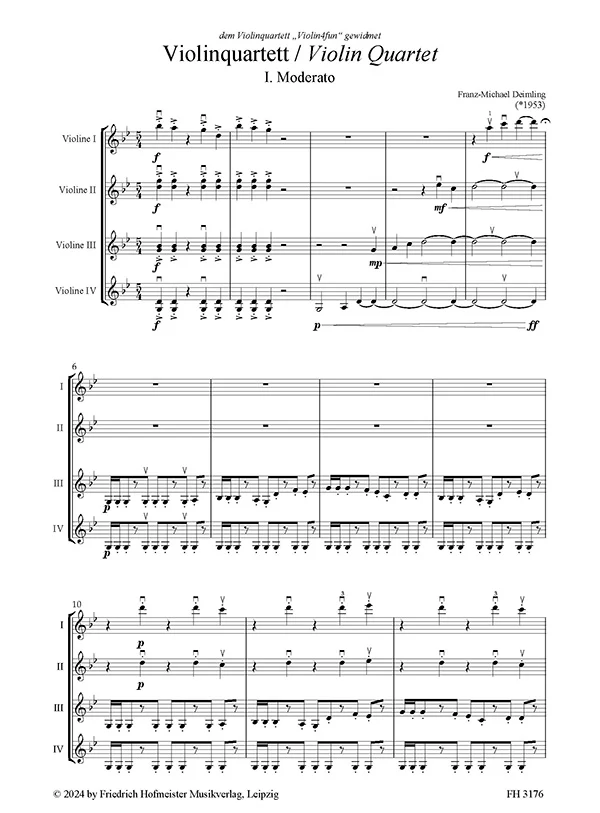
The Violin Quartet in G minor, Op. 89 consists of three movements, with the opening movement accounting for roughly half of the total performance time. While the first movement in G minor—with its alternating 5/4 and 2/4 time signatures—still shows traces of a sonata form, the following two movements follow a three-part A–B–A structure. The third movement features an Adagio middle section with extended pizzicato passages.
This quartet presents a variety of challenges for educational use. In the first movement, these include developing pizzicato technique, achieving a balance between pizzicato and arco playing, imitative passages, melodic phrasing, and rhythmic precision. The second movement focuses on linear playing and fading, gong-like tones. In the first movement, the first violin faces special challenges in the free-style passage, and in the third movement in handling double stops. Additional challenges in the final movement include refined bow control and articulation.
Product Information
Product Information
Shipping & Returns
Shipping & Returns
Deimling: Violin Quartet in G minor, Op. 89 (Score and Parts)
Deimling: Violin Quartet in G minor, Op. 89 (Score and Parts)
The Violin Quartet in G minor, Op. 89 consists of three movements, with the opening movement accounting for roughly half of the total performance time. While the first movement in G minor—with its alternating 5/4 and 2/4 time signatures—still shows traces of a sonata form, the following two movements follow a three-part A–B–A structure. The third movement features an Adagio middle section with extended pizzicato passages.
This quartet presents a variety of challenges for educational use. In the first movement, these include developing pizzicato technique, achieving a balance between pizzicato and arco playing, imitative passages, melodic phrasing, and rhythmic precision. The second movement focuses on linear playing and fading, gong-like tones. In the first movement, the first violin faces special challenges in the free-style passage, and in the third movement in handling double stops. Additional challenges in the final movement include refined bow control and articulation.
Original: $39.95
-65%$39.95
$13.98Product Information
Product Information
Shipping & Returns
Shipping & Returns
Description
The Violin Quartet in G minor, Op. 89 consists of three movements, with the opening movement accounting for roughly half of the total performance time. While the first movement in G minor—with its alternating 5/4 and 2/4 time signatures—still shows traces of a sonata form, the following two movements follow a three-part A–B–A structure. The third movement features an Adagio middle section with extended pizzicato passages.
This quartet presents a variety of challenges for educational use. In the first movement, these include developing pizzicato technique, achieving a balance between pizzicato and arco playing, imitative passages, melodic phrasing, and rhythmic precision. The second movement focuses on linear playing and fading, gong-like tones. In the first movement, the first violin faces special challenges in the free-style passage, and in the third movement in handling double stops. Additional challenges in the final movement include refined bow control and articulation.


