Kuhnau Daran erkennen wir, dass wir in Ihm bleiben
Cantata for Whitsunday – Urtext edited by David Erler
Vocal Score
The cantata Daran erkennen wir, dass wir in Ihm bleiben is intended for the first Whitsun holiday. It is based on a text by Johann Christoph Wentzel (1659–1723), the yearly volume in which it appears dates to August 4, 1703 and is dedicated to, among others, “Hn. Joh. Kuhnau / | Chori Musici bey der | Stadt Leipzig Directori” [Herr Joh. Kuhnau / Director of Choral Music at the City of Leipzig]. It can be assumed that Kuhnau’s composition originated near the time of the text, thus within his first years in office as the Leipzig St. Thomas cantor. Kuhnau follows the structure of Wentzel’s poem in a Dictum and four verses with introductory sonata, although some details are varied.
In comparison to other works by Kuhnau, the scoring is fairly large with five vocal parts, trumpets, timpani, oboes, and bassoon as well as two violins and violas each. The short performing time, on the other hand, makes the cantata suitable for liturgical use, too.
Product Information
Product Information
Shipping & Returns
Shipping & Returns
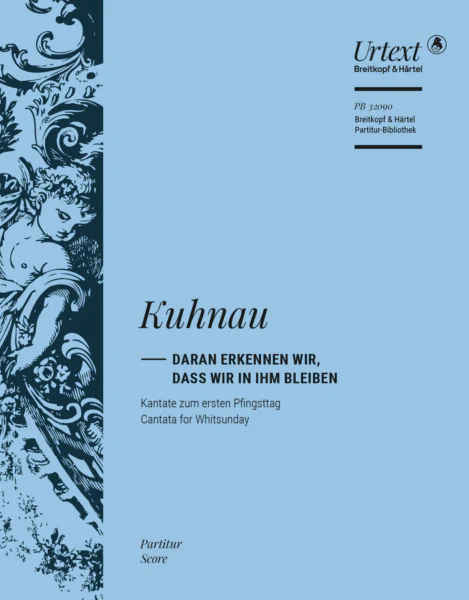
Kuhnau Daran erkennen wir, dass wir in Ihm bleiben
Kuhnau Daran erkennen wir, dass wir in Ihm bleiben
Cantata for Whitsunday – Urtext edited by David Erler
Vocal Score
The cantata Daran erkennen wir, dass wir in Ihm bleiben is intended for the first Whitsun holiday. It is based on a text by Johann Christoph Wentzel (1659–1723), the yearly volume in which it appears dates to August 4, 1703 and is dedicated to, among others, “Hn. Joh. Kuhnau / | Chori Musici bey der | Stadt Leipzig Directori” [Herr Joh. Kuhnau / Director of Choral Music at the City of Leipzig]. It can be assumed that Kuhnau’s composition originated near the time of the text, thus within his first years in office as the Leipzig St. Thomas cantor. Kuhnau follows the structure of Wentzel’s poem in a Dictum and four verses with introductory sonata, although some details are varied.
In comparison to other works by Kuhnau, the scoring is fairly large with five vocal parts, trumpets, timpani, oboes, and bassoon as well as two violins and violas each. The short performing time, on the other hand, makes the cantata suitable for liturgical use, too.
Original: $15.95
-65%$15.95
$5.58Product Information
Product Information
Shipping & Returns
Shipping & Returns
Description
Cantata for Whitsunday – Urtext edited by David Erler
Vocal Score
The cantata Daran erkennen wir, dass wir in Ihm bleiben is intended for the first Whitsun holiday. It is based on a text by Johann Christoph Wentzel (1659–1723), the yearly volume in which it appears dates to August 4, 1703 and is dedicated to, among others, “Hn. Joh. Kuhnau / | Chori Musici bey der | Stadt Leipzig Directori” [Herr Joh. Kuhnau / Director of Choral Music at the City of Leipzig]. It can be assumed that Kuhnau’s composition originated near the time of the text, thus within his first years in office as the Leipzig St. Thomas cantor. Kuhnau follows the structure of Wentzel’s poem in a Dictum and four verses with introductory sonata, although some details are varied.
In comparison to other works by Kuhnau, the scoring is fairly large with five vocal parts, trumpets, timpani, oboes, and bassoon as well as two violins and violas each. The short performing time, on the other hand, makes the cantata suitable for liturgical use, too.


