Ligeti Atmosphères
"Atmosphères" famously overturns all traditional categories of Western classical music. There is absolutely no discernible melody, harmony is reduced to the drifting of saturated chromatic clusters, and pulse - or any sense of normal rhythmical articulation - is entirely absent. All habitual structural sign-posts are also missing as is any relationship to standard forms, despite the ghost of a recapitulation towards the work's end. Instead the listener is confronted with a slow-motion succession of textures, one oozing into the other, where the instrumental sonority seems to have more in common with the dissolves and hums of electronic music than that of a normal symphony orchestra. Tiny traces of influence can just be discerned - perhaps Debussy, a little Richard Strauss, certainly Bartok - though Ligeti's vision is of startling, indeed radical, originality. (George Benjamin)
Product Information
Product Information
Shipping & Returns
Shipping & Returns
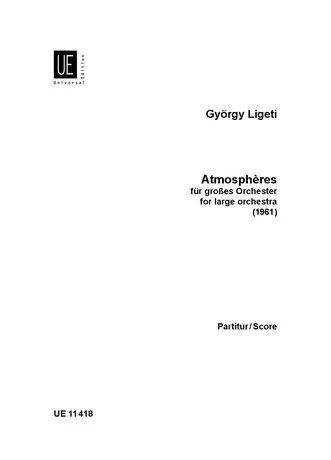
Ligeti Atmosphères
Ligeti Atmosphères
"Atmosphères" famously overturns all traditional categories of Western classical music. There is absolutely no discernible melody, harmony is reduced to the drifting of saturated chromatic clusters, and pulse - or any sense of normal rhythmical articulation - is entirely absent. All habitual structural sign-posts are also missing as is any relationship to standard forms, despite the ghost of a recapitulation towards the work's end. Instead the listener is confronted with a slow-motion succession of textures, one oozing into the other, where the instrumental sonority seems to have more in common with the dissolves and hums of electronic music than that of a normal symphony orchestra. Tiny traces of influence can just be discerned - perhaps Debussy, a little Richard Strauss, certainly Bartok - though Ligeti's vision is of startling, indeed radical, originality. (George Benjamin)
Product Information
Product Information
Shipping & Returns
Shipping & Returns
Description
"Atmosphères" famously overturns all traditional categories of Western classical music. There is absolutely no discernible melody, harmony is reduced to the drifting of saturated chromatic clusters, and pulse - or any sense of normal rhythmical articulation - is entirely absent. All habitual structural sign-posts are also missing as is any relationship to standard forms, despite the ghost of a recapitulation towards the work's end. Instead the listener is confronted with a slow-motion succession of textures, one oozing into the other, where the instrumental sonority seems to have more in common with the dissolves and hums of electronic music than that of a normal symphony orchestra. Tiny traces of influence can just be discerned - perhaps Debussy, a little Richard Strauss, certainly Bartok - though Ligeti's vision is of startling, indeed radical, originality. (George Benjamin)


