✨ New Arrivals Just Dropped!Explore
Liszt Ave Maria von Arcadelt
Franz Liszt composed his lyrical-meditative organ fantasia on the Ave Maria von Arcadelt in Rome in 1863. In contrast to his major virtuoso works, this charming genre piece can even be easily played on smaller (double-manual) instruments, even without swell-organand reeds. The 'Liszt organ' at the village church of Denstedt near Weimar, which was built by the Peternell brothers in 1859/60 and has survived in its original state, may be used as an example. It did not become known until 1927 that the Ave Maria attributed to Jakob Arcadelt (around 1505-1568) was a revised version by the composer Pierre-Louis-Philippe Dietsch (1808-1865) who used the melody of Arcadelt's chanson Nous voyons que les hommes which he then harmonized into his own Romantic four-part choral setting and to which he added the sacred text as a contrafactum.
Product Information
Product Information
Shipping & Returns
Shipping & Returns
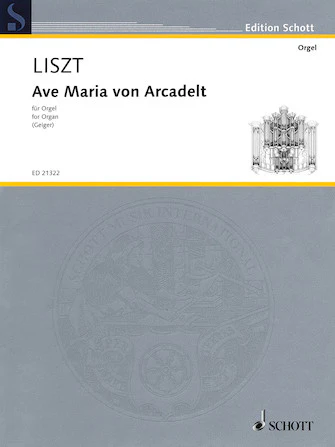
Liszt Ave Maria von Arcadelt
Liszt Ave Maria von Arcadelt
Franz Liszt composed his lyrical-meditative organ fantasia on the Ave Maria von Arcadelt in Rome in 1863. In contrast to his major virtuoso works, this charming genre piece can even be easily played on smaller (double-manual) instruments, even without swell-organand reeds. The 'Liszt organ' at the village church of Denstedt near Weimar, which was built by the Peternell brothers in 1859/60 and has survived in its original state, may be used as an example. It did not become known until 1927 that the Ave Maria attributed to Jakob Arcadelt (around 1505-1568) was a revised version by the composer Pierre-Louis-Philippe Dietsch (1808-1865) who used the melody of Arcadelt's chanson Nous voyons que les hommes which he then harmonized into his own Romantic four-part choral setting and to which he added the sacred text as a contrafactum.
$13.99
Liszt Ave Maria von Arcadelt—
$13.99
Product Information
Product Information
Shipping & Returns
Shipping & Returns
Description
Franz Liszt composed his lyrical-meditative organ fantasia on the Ave Maria von Arcadelt in Rome in 1863. In contrast to his major virtuoso works, this charming genre piece can even be easily played on smaller (double-manual) instruments, even without swell-organand reeds. The 'Liszt organ' at the village church of Denstedt near Weimar, which was built by the Peternell brothers in 1859/60 and has survived in its original state, may be used as an example. It did not become known until 1927 that the Ave Maria attributed to Jakob Arcadelt (around 1505-1568) was a revised version by the composer Pierre-Louis-Philippe Dietsch (1808-1865) who used the melody of Arcadelt's chanson Nous voyons que les hommes which he then harmonized into his own Romantic four-part choral setting and to which he added the sacred text as a contrafactum.