Mahler Des Knaben Wunderhorn (The Youth's Magic Horn) for low voice and piano
15 songs, humoresques and ballads
This edition is more oriented to practical performance than the New Complete Critical Edition. From the range designations of the Lieder, one can see that, despite the transpositions, not all fifteen Lieder of a volume are suited to one and the same voice. The alternative pitches and easier passages written by Mahler often for only one of the voice ranges of a Lied (and not necessarily always for the "original" voice range) are here provided for both voices. The "Notes" (pp.165-170) show for which voice these were originally conceived and whether this has to do with a purely vocal facilitation or a musical variant. Unlike the "Kindertotenlieder", the fifteen "Wunderhorn" Lieder do not form a cycle and do not even suggest a unified collection of songs such as the "Rückert" Lieder. They can only be organized according to their sequence of composition, which should, however, have no influence on the choice or order of a performance. As Mahler himself urged upon his singers: "I ask at the very least that you determine the sequence of the Lieder yourself." (Letter to the baritone Johannes Messchaert, 1906)
Table of contents:
Der Schildwache Nachtlied
Verlorne Müh'!
Wer hat dies Liedlein erdacht?
Das himmlische Leben
Trost im Unglück
Das irdische Leben
Urlicht
Des Antonius von Padua Fischpredigt
Rheinlegendchen
"Es sungen drei Engel einen süßen Gesang"
Lob des hohen Verstands
Lied des Verfolgten im Turm
Wo die schönen Trompeten blasen
Revelge
Der Tamboursg'sell
Product Information
Product Information
Shipping & Returns
Shipping & Returns
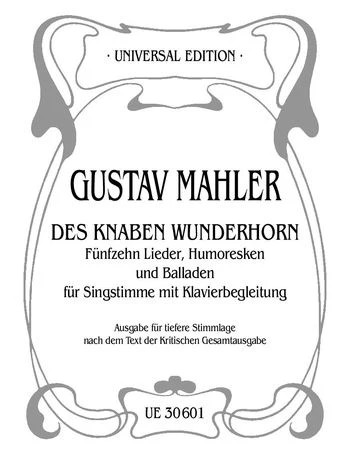
Mahler Des Knaben Wunderhorn (The Youth's Magic Horn) for low voice and piano
Mahler Des Knaben Wunderhorn (The Youth's Magic Horn) for low voice and piano
15 songs, humoresques and ballads
This edition is more oriented to practical performance than the New Complete Critical Edition. From the range designations of the Lieder, one can see that, despite the transpositions, not all fifteen Lieder of a volume are suited to one and the same voice. The alternative pitches and easier passages written by Mahler often for only one of the voice ranges of a Lied (and not necessarily always for the "original" voice range) are here provided for both voices. The "Notes" (pp.165-170) show for which voice these were originally conceived and whether this has to do with a purely vocal facilitation or a musical variant. Unlike the "Kindertotenlieder", the fifteen "Wunderhorn" Lieder do not form a cycle and do not even suggest a unified collection of songs such as the "Rückert" Lieder. They can only be organized according to their sequence of composition, which should, however, have no influence on the choice or order of a performance. As Mahler himself urged upon his singers: "I ask at the very least that you determine the sequence of the Lieder yourself." (Letter to the baritone Johannes Messchaert, 1906)
Table of contents:
Der Schildwache Nachtlied
Verlorne Müh'!
Wer hat dies Liedlein erdacht?
Das himmlische Leben
Trost im Unglück
Das irdische Leben
Urlicht
Des Antonius von Padua Fischpredigt
Rheinlegendchen
"Es sungen drei Engel einen süßen Gesang"
Lob des hohen Verstands
Lied des Verfolgten im Turm
Wo die schönen Trompeten blasen
Revelge
Der Tamboursg'sell
Original: $59.95
-65%$59.95
$20.98Product Information
Product Information
Shipping & Returns
Shipping & Returns
Description
15 songs, humoresques and ballads
This edition is more oriented to practical performance than the New Complete Critical Edition. From the range designations of the Lieder, one can see that, despite the transpositions, not all fifteen Lieder of a volume are suited to one and the same voice. The alternative pitches and easier passages written by Mahler often for only one of the voice ranges of a Lied (and not necessarily always for the "original" voice range) are here provided for both voices. The "Notes" (pp.165-170) show for which voice these were originally conceived and whether this has to do with a purely vocal facilitation or a musical variant. Unlike the "Kindertotenlieder", the fifteen "Wunderhorn" Lieder do not form a cycle and do not even suggest a unified collection of songs such as the "Rückert" Lieder. They can only be organized according to their sequence of composition, which should, however, have no influence on the choice or order of a performance. As Mahler himself urged upon his singers: "I ask at the very least that you determine the sequence of the Lieder yourself." (Letter to the baritone Johannes Messchaert, 1906)
Table of contents:
Der Schildwache Nachtlied
Verlorne Müh'!
Wer hat dies Liedlein erdacht?
Das himmlische Leben
Trost im Unglück
Das irdische Leben
Urlicht
Des Antonius von Padua Fischpredigt
Rheinlegendchen
"Es sungen drei Engel einen süßen Gesang"
Lob des hohen Verstands
Lied des Verfolgten im Turm
Wo die schönen Trompeten blasen
Revelge
Der Tamboursg'sell