✨ New Arrivals Just Dropped!Explore
Scriabin: Impromptus à la mazur for Piano, Op. 7
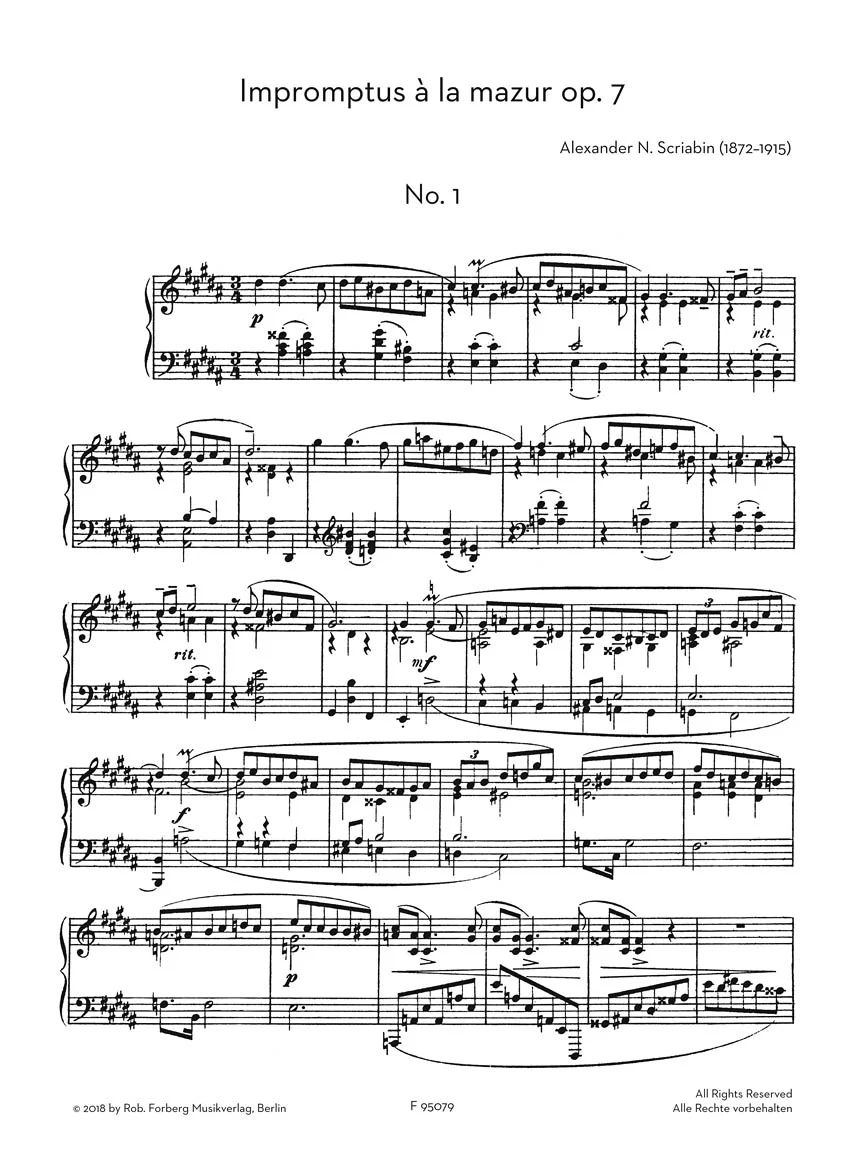
In the two Impromptus à la mazur op. 7 by Alexander Scriabin (1872-1915) the influence of Chopin is clearly evident. Chopin's music constitutes the point of departure in a musical progression that would lead the Russian composer far along a pathway towards a new and revolutionary language. In the first Impromptu à la mazur, in G-Sharp Minor, the prevalent tone is one of melancholic grace. The second, in F-Sharp Major, is more iridescent and ranges from the marked accentuations in the central section to passages in which the writing is instead almost pulverized in arabesques, prefiguring future sonoric transfigurations.
Product Information
Product Information
Shipping & Returns
Shipping & Returns


Scriabin: Impromptus à la mazur for Piano, Op. 7
Scriabin: Impromptus à la mazur for Piano, Op. 7
In the two Impromptus à la mazur op. 7 by Alexander Scriabin (1872-1915) the influence of Chopin is clearly evident. Chopin's music constitutes the point of departure in a musical progression that would lead the Russian composer far along a pathway towards a new and revolutionary language. In the first Impromptu à la mazur, in G-Sharp Minor, the prevalent tone is one of melancholic grace. The second, in F-Sharp Major, is more iridescent and ranges from the marked accentuations in the central section to passages in which the writing is instead almost pulverized in arabesques, prefiguring future sonoric transfigurations.
$4.55
Original: $12.99
-65%Scriabin: Impromptus à la mazur for Piano, Op. 7—
$12.99
$4.55Product Information
Product Information
Shipping & Returns
Shipping & Returns
Description
In the two Impromptus à la mazur op. 7 by Alexander Scriabin (1872-1915) the influence of Chopin is clearly evident. Chopin's music constitutes the point of departure in a musical progression that would lead the Russian composer far along a pathway towards a new and revolutionary language. In the first Impromptu à la mazur, in G-Sharp Minor, the prevalent tone is one of melancholic grace. The second, in F-Sharp Major, is more iridescent and ranges from the marked accentuations in the central section to passages in which the writing is instead almost pulverized in arabesques, prefiguring future sonoric transfigurations.